ClientDe Vries Werkendam
LocationNoorderkade, Beverwijk
ProductDENS Powerhub
Year2025
Powerhub as the driving force behind zero emission sheet piling
Working with heavy equipment without local emissions is possible. De Vries Werkendam proved it in Beverwijk, where the team installed sheet piles at Noorderkade without exhaust fumes or noise from a diesel generator. The project relied on a DENS Powerhub as the primary power source.
De Vries Werkendam is renewing the quay along Zeehaven De Pijp in Beverwijk. The scope includes 330 metres of sheet piles on the Noorderkade. Sustainability was a key tender requirement. By proposing a zero emission execution, De Vries Werkendam won the contract and used the project as a pilot to build practical experience.
Why drive electrically?
Urban marine works demand low emissions and low noise. Parking a diesel generator next to an electric vibro hammer makes little sense, smells, and disturbs the neighbourhood. This pilot shows that a DENS Powerhub can deliver the same short power pulses a diesel set would provide, but almost silently and without exhaust gases, resulting in direct CO₂ reduction. That is better for crews and for residents.
Working from the water
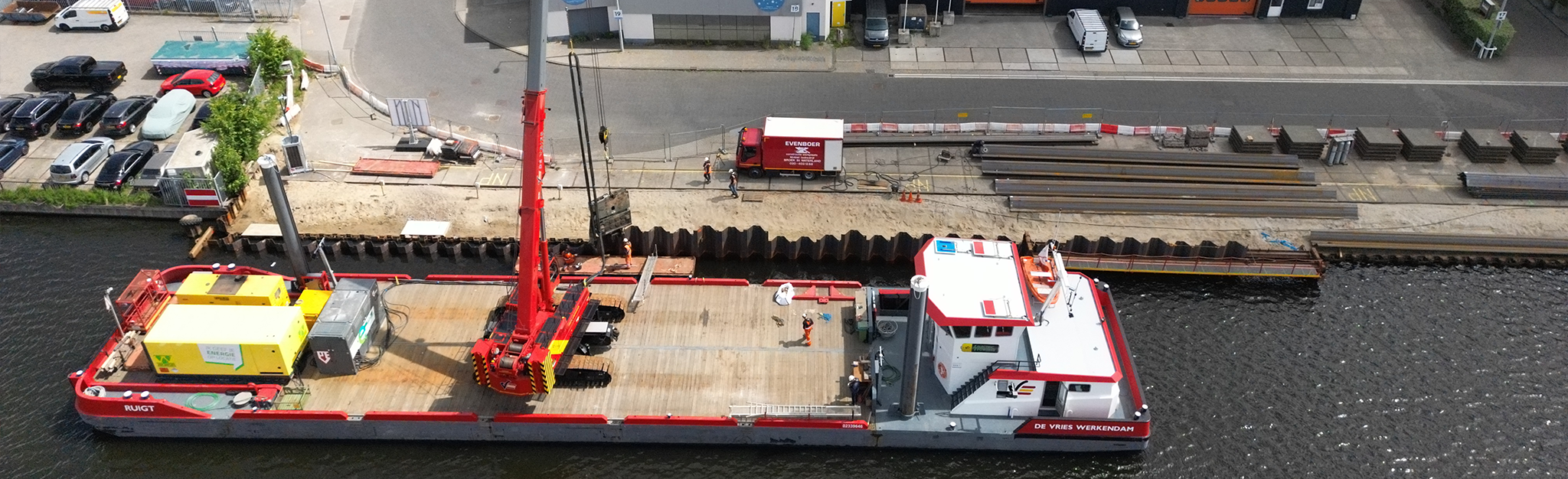
The sheet piles were driven from a work barge. An electric Sany crane handled a PVE 15 VCM hydraulic vibro hammer mounted on the boom. Hydraulic power came from a Dieseko 700e Electric Hydraulic Power Unit placed on deck next to the crane. The pumps in this EHPU deliver up to 725 litres per minute at 350 bar and are driven by electric motors.
Those motors were powered by a large battery. De Vries Werkendam used a 1160 kWh DENS Powerhub supplied by Van Werven.

Double-shift operations
Van Werven and De Vries sized the system together with DENS engineers, looking closely at both energy capacity and peak power. The decisive factor was the plan to work two shifts per day, from 05:00 to 23:00. That creates long operating windows and short charging windows.
The team therefore chose not to draw all required energy from the Powerhub alone but to recharge between shifts. “That is quite unique in our systems,” says Thijs Geerts, engineer at DENS. “We can charge and discharge at the same time, so work can continue during charging.”
Project data for Noorderkade
The municipal contract called for 330 metres of new quay and 360 metres of sheet piles. Work ran in two crews from early morning to late evening. The battery system had to supply frequent power peaks while maintaining its own balance between charges.
Key figures over the seven-week period:
- Total energy use: 17.2 MWh
- Daily consumption: between 0.5 and 1.0 MWh
- Charging sessions: > 40
- CO₂-reduction
Daily energy use up to 1 mWh
Day to day consumption ranged from about 500 kWh up to 1 MWh. Most of that went to the electric hydraulic pumps in the EHPU. The grout mixer and water pumps added to the load. The electric Sany crane also topped up during breaks to comfortably cover both shifts.
The DENS Powerhub is continuously monitored in a secure environment through a dashboard developed by DENS. Both the customer and DENS engineers can see key metrics.
“We do not only track the power being drawn,” Thijs explains. “We also follow battery temperatures and other health indicators, which lets us ensure continuity remotely.”
From late May to late July the site consumed a total of 17,226 kWh.

Operational experience
- Cable management: Two AC cable sets to the Hydropack;
- Battery monitoring: in a secure environment by the DENS service team;
- Sustainability: Lower emissions thanks to controlled charging;
- Flexibility: After the work on the sheet piling was completed, the Powerhub was placed on shore to charge electrical equipment there; multi-purpose.

Conclusion
This pilot demonstrates that zero emission sheet-pile driving is practical with a mobile battery. The client benefits from lower fuel costs, a quieter jobsite, and a stronger score on the project’s CO₂ performance ladder.